

GRANT INTELLIGENCE · APPLICATION WRITING
Your department qualifies for money it is not asking for.
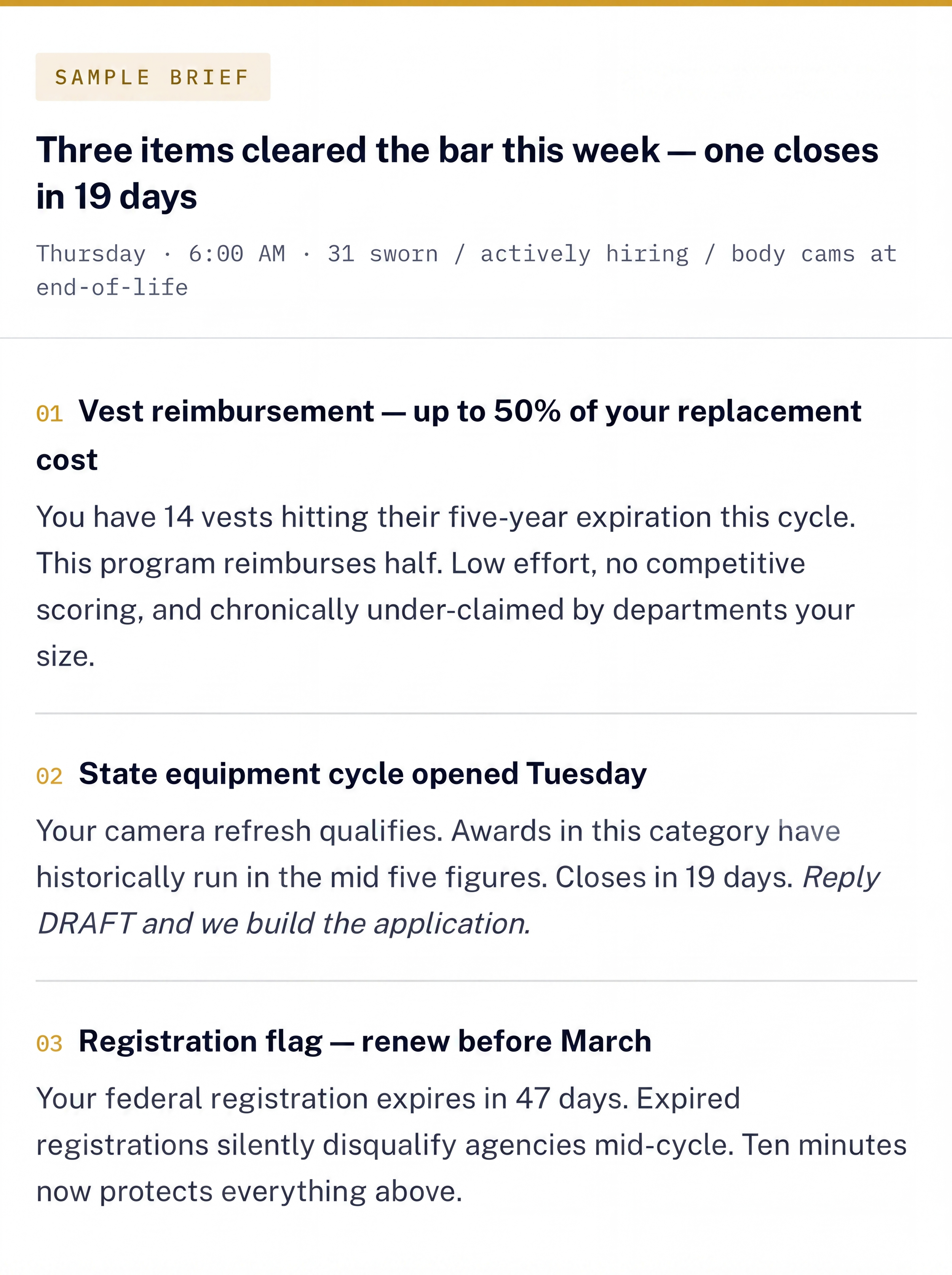
VaultBeat watches every federal, state, and private funding source against your department's exact profile, then sends one email a week: what you qualify for, why you qualify, and when it closes. When you want one of them, we write the application.
15-minute intake. First brief within a week.
Every other tool hands your staff a search box. VaultBeat does the searching.Your command staff reads one email.
HOW IT WORKS
One form. Then it runs without you.
The profile is the only work your department ever does. Everything after it happens on our side.
STEP 01
You fill out one profile
Size, staffing, vacancies, equipment age, budget cycle, match capacity, and your top three priorities. Ten minutes, once. Match funding is the field that quietly kills eligibility — we ask it up front so nothing gets recommended that you can't actually accept.
STEP 02
We monitor everything
Federal programs, state pass-through cycles, opioid settlement dollars, surplus equipment, free training, and private foundations. Every source gets scored against your profile. Only real matches make your brief.
STEP 03
You reply DRAFT
When something is worth pursuing, one word starts it. We write the narrative, build the budget and budget narrative, assemble the attachments, and hand you a submission-ready package for your review.
COVERAGE
Not just grants.
Most of what a department can claim is not a grant at all. It's surplus, reimbursement, settlement money, and free assistance nobody sends you a notice about.
Federal grants
Hiring, equipment, technology, school safety, violence prevention, victim services, mental-health co-response, and rural facility funding.
Surplus & discounted equipment
Federal and state surplus programs move vehicles, body armor, optics, and computers for the cost of shipping. Separate programs let you buy new gear at federal contract pricing.
State pass-through
Every state runs its own criminal justice, highway safety, and homeland security cycles. This is where small departments actually win, and it's the least monitored.
Free training & assistance
No-cost technical assistance, policy review, leadership mentoring, and specialized training that a department your size would otherwise pay a consultant for.
Opioid settlement funds
Billions are already sitting with counties and municipalities. Most chiefs don't know they're allowed to ask for a share. We tell you who to ask and for what.
Private foundations
Officer safety equipment, K9 funding and vests, thermal imaging, and community program dollars — much of it rolling, uncompetitive, and rarely applied for.

PRICING
Flat fees. No percentage of your award.
Contingency and percentage-of-award fees are not an allowable grant cost under federal rules. Everything here is a flat fee, which also means it's a line item your finance office already knows how to process.
TIER ONE
VaultBeat Brief
$275
PER MONTH · NO CONTRACT
Weekly brief written for your department only
Urgent alerts between briefs when a deadline-critical match appears
Annual Funding Map — everything you're eligible for this fiscal year, on one page
Legislative watch on changes affecting your eligibility
Registration monitoring so an expired record never costs you a cycle
Priced to sit under most departments' small-purchase limits — in most cases a card or a simple PO, not a procurement process.
TIER TWO
VaultBeat Draft
$2,500
FLAT, PER APPLICATION
The full application written and assembled, start to finish
Project narrative built from your profile and your actual need
Budget and budget narrative aligned to program rules
Attachment checklist and submission walkthrough in your portal
No cap on how many you request in a year
One awarded application typically returns many multiples of this fee. You approve every word before we hand over the final draft.
QUESTIONS CHIEFS ASK
The straight answers.
-
Two ways. First, VaultBeat sells nothing else to police departments — no equipment, no software, no services. Nothing in your brief is something we profit from you buying, so the recommendations are driven only by what you're eligible for.
Second, the subscription databases are search tools. They're legitimate, but they assume someone on your staff has hours a week to run searches and interpret eligibility rules. Most departments under 50 sworn don't have that person. VaultBeat is the opposite model: nobody on your side searches anything.
-
For the largest competitive federal awards, sometimes not — and we'll tell you that rather than waste your time. But a lot of what a small department can claim doesn't turn on competing well: reimbursement programs, surplus property, rolling private grants, and settlement dollars already allocated to your county. Where it is competitive — most state pass-through cycles are — small agencies usually lose on bandwidth rather than merit, because nobody had time to apply.
-
No. Percentage-of-award pricing creates an obvious incentive problem — you'd never know whether we recommended something because you qualify or because it's big. Beyond that, grant-writing fees are treated as proposal costs under federal cost principles, which makes them awkward to charge against an award and a recurring audit headache. Brief is a flat monthly fee. Draft is a flat fee per application, quoted before we start, whether it's funded or not.
-
Your profile covers most of it. For a specific application we'll usually need current staffing and vacancy numbers, relevant incident or call data, and a short conversation about what the money would actually do. Typically under an hour of your staff's time.
We draft, you review, you submit. Your agency stays the applicant of record.
-
Good — they're who you'll route the award through. But a city grants coordinator covers every department, and law enforcement funding is its own world: DOJ portals, state criminal justice cycles, surplus programs, settlement dollars, registration requirements nobody else in the building deals with. VaultBeat finds and writes; your coordinator handles the city-side process. It's not a replacement, and departments with a coordinator usually get more out of this, not less.
-
No. Anyone who guarantees a grant award is either misinformed or not being straight with you. What we control is that you know about every opportunity you qualify for, that you don't miss a deadline, and that the application you submit is complete, compliant, and well argued.
-
The intake form takes about fifteen minutes. Your first brief lands within a week. If something time-critical is already open for you, you'll hear about it before that.
-
Cancel by replying to any brief. No contract, no term, no cancellation process. If the briefs aren't surfacing money you didn't know about, they aren't worth your inbox and we'd rather you say so.
-
The monitoring and matching are automated. Applications are different — a human writes them, and nothing reaches you that hasn't been read line by line by someone who knows what a reviewer scores.